


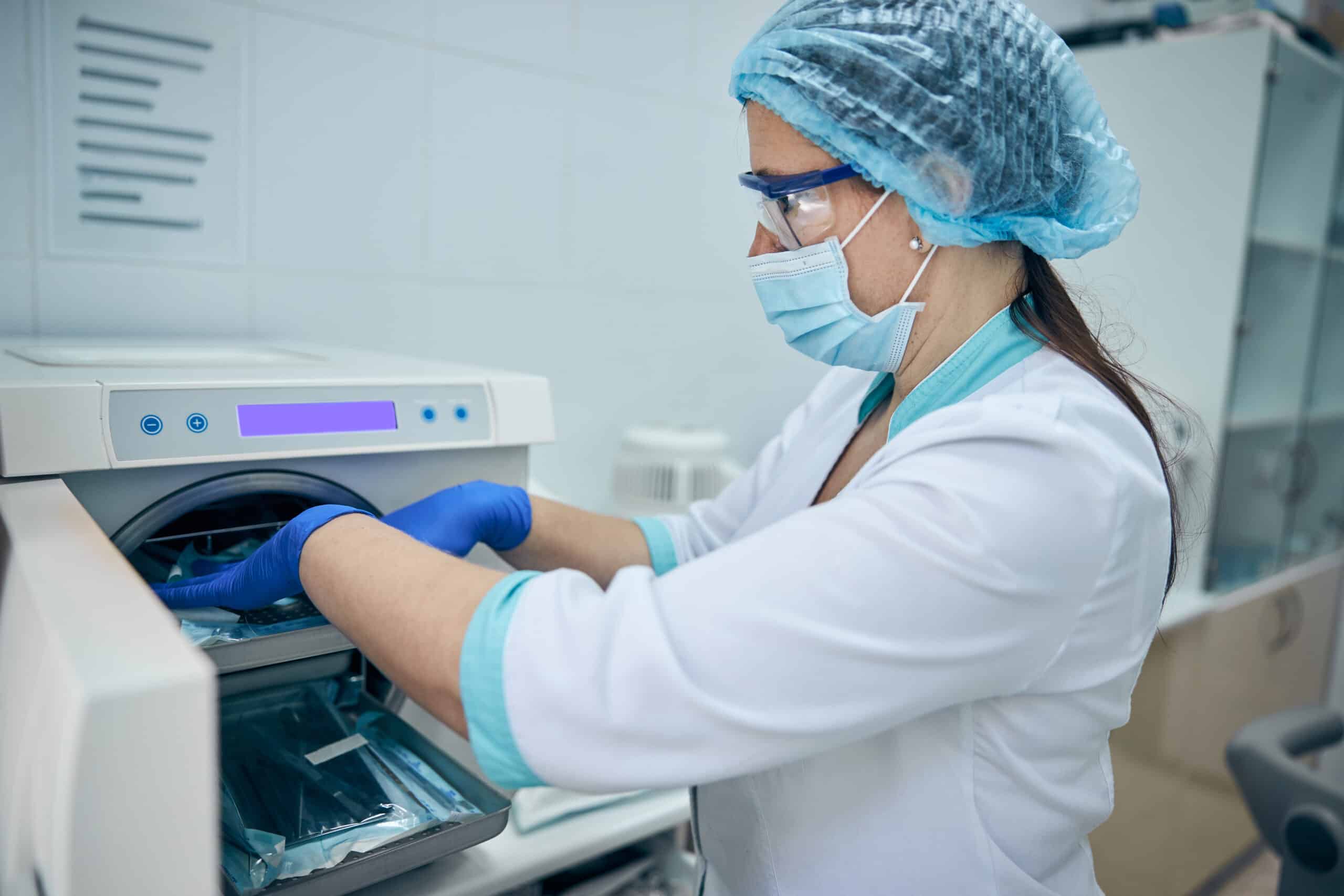
Reprocessing of medical devices: sterilization validation – steam sterilization
As already explained in the blog post on cleaning validation, a certain level of cleanliness is required for successful disinfection or sterilisation as part of the reprocessing procedure. The previous post on disinfection validation demonstrated that disinfection is not always sufficient as the final cleaning step. Both the FDA and the EU require sterilization as the final reprocessing step for products of a certain criticality. There are various sterilisation methods, but this article focuses on the most common one – steam sterilization. It is based on the regulatory frameworks of the EU and the FDA.
Regulatory Background and Fundamentals
A sterile medical device is free from viable microorganisms. The aim of sterilization is to inactivate any present microorganisms and to bring the product to a sterile state. The ISO 17665 sets out requirements for steam sterilization and ensures that the process is effective, reliable and reproducible. It can therefore be assumed that the probability of any microorganisms remaining is very low. The exact level to which this probability must be reduced is specified by regulations and may vary from country to country, for example in EN 556‑1 or ANSI/AAMI ST67. (Content in accordance with ISO 17665).
The probability of a single viable microorganism being present on an item following sterilisation is referred to as the sterility assurance level and is usually abbreviated to SAL – sterility assurance level. EN 556‑1 and EN 556‑2 further define requirements for medical devices labelled as ‘sterile’. This series of standards stipulates that sterilisation processes must generally be validated and regularly monitored in order to achieve a sterility assurance level at which the probability of a microorganism surviving is no greater than 10⁻⁶.
The determination of microbial contamination on products is described in ISO 11737‑1. The total number of viable microorganisms on a product is referred to as the bioburden. This bioburden is relevant as a starting point for successful sterilization with a SAL of no more than 10⁻⁶
ISO 11737‑2 additionally specifies general requirements for sterility testing. These tests are carried out on products that have been treated using a sterilisation process that is less rigorous than the routine process. They are typically used in the definition, validation and monitoring of sterilization processes.
For the test, a so-called sample item portion (SIP) is defined, i.e. the part of the product that is actually tested. If the distribution of the bioburden on the product is unknown, the samples must be selected in such a way that all materials used are represented. The suitability of the SIP must be demonstrated, taking into account criteria such as length, mass, volume and surface area, as described, amongst other things, in ISO 11137‑2.
Sterility testing of solid products is usually carried out either by direct immersion in the culture medium or by adding the culture medium to the product followed by incubation. During this time, the product should be completely immersed in the medium. If this is not possible, for example in the case of floating materials, this must be justified accordingly.
After incubation, the product is subjected to the sterilization process. This is followed by the sterility test, during which the culture medium is examined for microbial growth.
Overkill method
The efficacy of microbial inactivation in accordance with ISO 17665 can be demonstrated in various ways, for example on the basis of bioburden, through a combined method using bioburden and biological indicators, or by means of the overkill method. If biological indicators are used, they must comply with the requirements of ISO 11138‑1 and ISO 11138‑3. This can be achieved either by directly inoculating the product or by introducing inoculated seed carriers into the product. If the product itself is inoculated, it can be regarded as a biological indicator.
Whilst methods based on bioburden require knowledge of the bioburden, the overkill method is regarded as a conservative approach, as the bioburden is not taken into account here. This method is frequently used for the validation of reusable medical devices and aims to achieve a sterility assurance level (SAL) of no more than 10⁻⁶.
As part of the validation process, packaged biological indicators or test specimens (PCDs) are deliberately positioned at the points within the load that are most difficult to sterilise. The load should be selected so that it at least reflects or exceeds the requirements of the subsequent routine load.
For medical devices that are reprocessed in healthcare facilities using an autoclave, the use of approximately 5 to 12 biological indicators per load is generally considered sufficient. Regardless of this, all relevant test areas of the product must be taken into account when positioning the indicators. In the case of complex configurations, such as multi-product trays or complete sets, it may be necessary to use a higher number of biological indicators to ensure an adequate microbiological test load. In the ‘overkill’ method, there are two approaches: validation using a half cycle (half retention time) or using a proportional retention time with cycle calculation.
Following the microbial inactivation test, a thermometric test is also carried out to ensure that the required temperatures are reached throughout the entire load. Furthermore, the dryness of the load should also be examined. Where possible, biological indicators should be placed within the load at points adjacent to the temperature sensors. In practice, the drying process, temperature measurement and SAL testing are often carried out separately.
Defining the test setup and validation
So much for the theory – but how is sterilisation validation implemented in practice? Firstly, it should be noted that this article focuses on reusable medical devices. Aspects of product cleanliness prior to sterilisation are therefore not covered in detail, although they are crucial to the success of reprocessing and sterilisation validation. Notified Bodies, in particular, are placing increasing emphasis on demonstrating the cleanliness of medical devices prior to sterilisation, as residual contaminants can compromise the effectiveness of the sterilization process.
As with cleaning validation, product families can be formed and a representative product selected for sterilisation validation. However, this does not necessarily have to be identical to the worst-case product used in cleaning validation. Rather, sterilisation-relevant properties such as material, surface, any lumens present and the product’s dimensions are decisive for the selection. Different materials and wall thicknesses, for example, influence heat absorption and the temperature profile during the sterilisation process and can thus have a significant impact on the validation result.
Once the representative product has been selected, detailed planning of the validation begins. Whilst the validation of the sterility assurance level is often carried out in a half-cycle, temperature distribution and drying performance are usually investigated in a full cycle. The positions at which biological indicators and temperature sensors are to be placed must be determined at this stage. The selection of these test points should be justified in a transparent manner and focus on the areas that are most difficult to sterilise or dry.
Equally important is the determination of the loading configuration. The chosen loading should represent a worst-case scenario and, at a minimum, reflect the requirements of the subsequent routine loading. If there are various options for loading trays, these must be evaluated and the selected configuration must be justified in a transparent manner. The same applies to the packaging of the products. If, for example, the medical devices are sterilised in pouches, the number of packaging layers – such as single or double – as well as the pouch materials used and their properties should be clearly defined. Only through careful planning and justification of all relevant influencing factors can it be ensured that the results of the sterilisation validation are reliable and transferable to subsequent routine operation.
Drying validation
In addition to the actual sterilisation process using an autoclave, drying plays a crucial role in maintaining sterility. Regulatory requirements stipulate that medical devices must be dry and undamaged after reprocessing, as residual moisture can compromise the sterile barrier and increase the risk of recontamination. Accordingly, drying validation must be regarded as an integral part of the overall process validation.
In practice, however, this often presents technical challenges. Complex product geometries, materials with high heat capacity or sealed packaging designs can lead to condensation remaining. Load combinations comprising products of varying weights or trays with restricted air circulation are particularly challenging. A systematic risk analysis and specifically defined test configurations are therefore essential to demonstrate adequate drying under all relevant conditions.
Outlook
Following successful validation, the documented sterilization and drying process forms the basis for market launch and subsequent routine operation. Once the product is on the market, feedback from real-world use becomes increasingly important. Findings from market surveillance, complaints or observations from audits provide valuable information on the actual robustness of the process.
This feedback should be systematically evaluated and taken into account as part of change and risk management. In this way, it not only contributes to compliance with regulatory requirements but also supports the continuous improvement of products and processes throughout their entire life cycle.